

On Human Touch
Seven hours at the Chicago ICE Field Office

Last week, I went into the Chicago ICE field office to pay a few bonds.
I did it as part of my work with the Midwest Immigration Bond Fund. We can usually pay bonds online, but this time for some reason or another, we had a handful of bonds that needed to be paid in person, and I thought, “oh, I don’t have a lot on at work at the moment, I’ll take the morning off and go take care of this,” despite never having paid an immigration bond in person before.
As it turns out, paying a bond in person is not hard. It involves, yes, carrying your person and your paperwork and probably a book or some knitting into the federal building at 101 W. Ida B. Wells, just south of the Loop. You go through metal detectors, and into some elevators, and you get spit out onto the 4th floor, into this small, kind of gross waiting room, like a doctor’s office but worse. There are only unpadded rolling chairs to sit in, and no windows to the outside, or tables to rest a coffee on or anything.
You take your paperwork over to the people behind the service windows, and they take it and your REAL ID, and they give you some forms to fill out, and you do it, and then they give you your ID back and tell you to sit, and you do that. Paying bonds in person usually takes around 3 hours. I don’t really know what they do behind the window with all the papers that you give them, or why this process takes three hours, it just does.
So I show up at this strange, windowless waiting room a little past 9 a.m., and I fill out the forms, and I sit down and play on my phone for a while, because I’m not very interested in the book I brought. And the whole time, other people are coming in and doing the paperwork and sitting down and waiting, and there’s a fair bit of interesting people watching you can do, sitting on a rolling chair in the ICE Field Office waiting room, so some of that is happening as well.
I was worried that the waiting room of the ICE Field Office would feel emotionally heavy, that these were people waiting for check-ins where they might be detained, or that there would be people in uniforms watching us all day, that the mechanics and horror of immigration enforcement in this country would be visible to me as I waited, but nope, not really. There were maybe little snatches of conversation, half-overheard allusions to deep sadnesses, but the overall feeling was like the DMV but worse, little family units entertaining themselves and chatting, the kind of exhausted waiting of bureaucracy, the blank-faced stares of people trying not to make eye contact, office workers doing stapling and customer service (with the added bonus that a lot of it involves arguing with lawyers who show up with their clients—a deeply deserved kind of customer service hell in my opinion).
At around noon, they said they were having system failures, and to go get lunch, and to come back after, to see what was going on. So I left, and I had a sad little fast food lunch and told my boss I might be out for the rest of the day, and then I went back into the ICE field office and sat back down to wait.
In a weird kind of opsec failure, you could see what was on the screens of the workers quite clearly from many places in the room, and so I spent a good portion of my day squinting at a computer screen some 25 feet away from me. One of the workers, from the moment I came in that morning, had, full screen on one of his two monitors, videos of a woman cleaning.
For hours, one monitor was email or web portals, while his other was an uninterrupted stream of an anonymous, faceless woman, wiping down surfaces. Table tops, electric stoves, phones, decorative bowls, screens, and a soft cloth methodically moving across all of it. Lifting up the phone receiver, wiping it, setting it down. Cut. A hand moving across a table, back and forth. Cut. One drawer pull after another, left shining. There was no visible dirt in the video, just visible cleaning. A thin, white, blond woman in athleisure, doing the endless labor of cleaning clean things.
I don’t know if this was some kind of a kink thing, or ASMR, or comforting, or relaxing or what, but I did find it profoundly sad. There’s a number of things you can read into it, project given the context. A desire for human touch and contact, running down every surface, instead sublimated to the endless touching of consumer goods. A longing for some kind of racial purity, a white woman endlessly wiping away dirt. A Lady-Macbeth-like desire to clean the invisible moral stain permeating the place, the computer, the man’s brain, but instead of hysterical (out, out damned spot!) eerily, methodically calm. Wipe. Wipe. Wipe.
Also, at my back on the wall were an extensive set of pencil drawings, clearly doodled by one of the many bored children that must pass through this waiting room. A big spiral, an attempt at letters. There were a lot of kids in the waiting room while I was there, sitting quietly while their parents bonded out their loved ones. These kids were good at waiting, at being quiet, but I can see (I could feel in my own body) the way that waiting like that has to, eventually, give way to naughtiness. Hence, a little scrawled pencil spiral on the wall, doodled while a parent was distracted. An illustration of how slow time goes, an expression of a very old impulse to say “I was here, I passed a while staring at this white wall, and I wanted it to look more like me.” I have seen the same thing in immigration detention centers, graffiti marking days passed, hometowns, prayers. Marking the human on the inhuman wall.
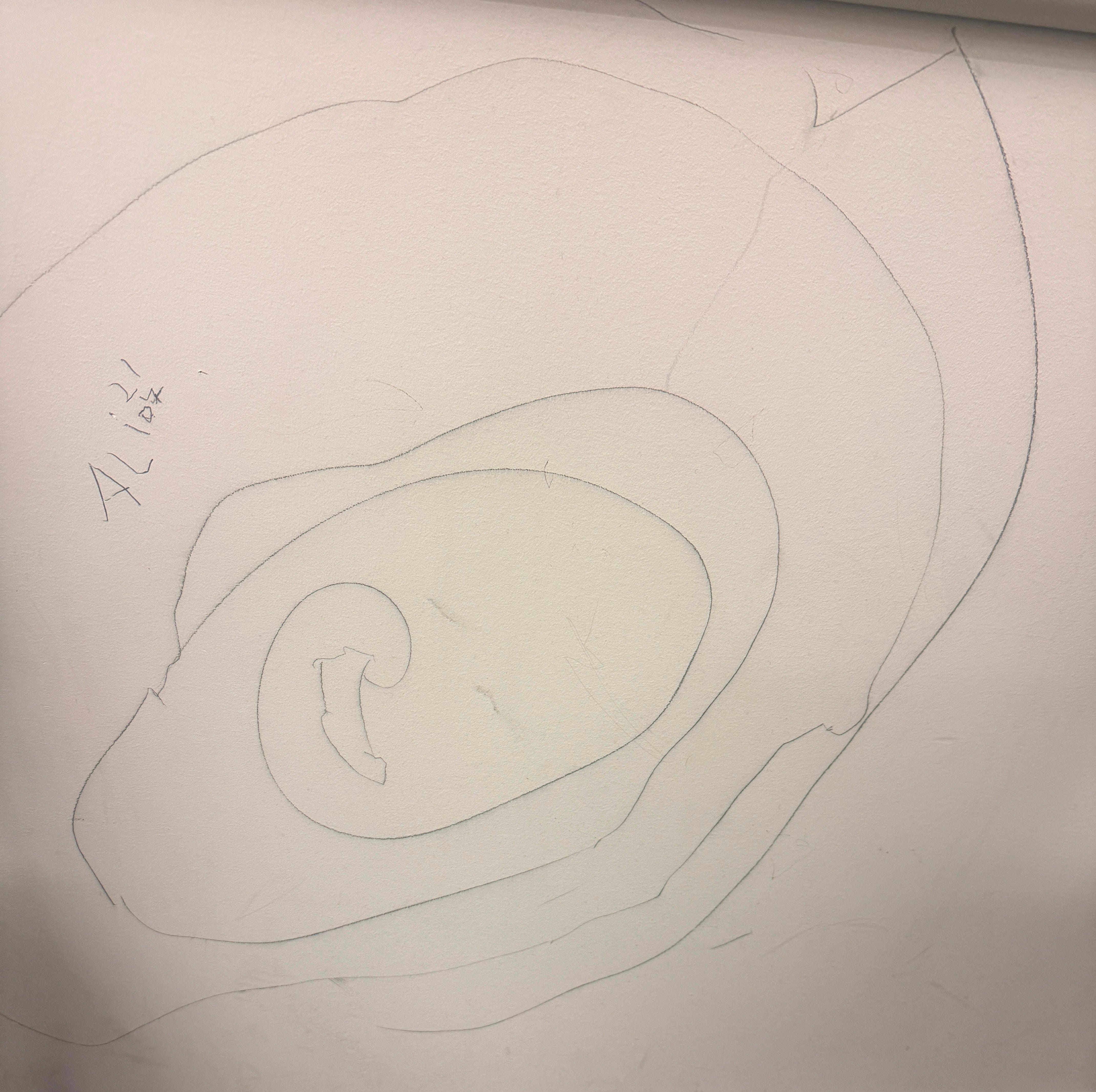
I was both surprised it was still up, that it had lasted over night and into the next morning, and also not—this is not a room that is cared for, it is just a room that exists. The only woman that exists to clean with the kind of detailed, loving attention required to erase out pencil markings is on a computer screen behind a glass partition, trapped in an endless cycle of performing.
Time ticked along, and I signed two of the three bonds I was there to pay, but the last one got stuck, somewhere in the system, and then it was 3 p.m., and the office closed and I went home. On my way home, I got a call that I had, somehow, managed to leave my wallet at the ICE office, and the final pending bond got approved, but they were closed, could I please come back tomorrow. And so the next day I got out of bed early, and I took myself back to 101 W. Ida B. Wells Drive (deep, awful, American irony, that an anti-lynching advocate gives her name to the street where ICE lives in Chicago) and I went through the metal detectors and took the elevator to the fourth floor, and was greeted, again, by videos of endless clean counters, getting cleaner.
The people behind the service windows are very nice, interpersonally, actually. (Nice is different than good.) They were very concerned about my wallet, and gave it back to me, and we all kind of laughed, and I asked if I could pay the last bond kind of quickish, and they said yes. I spent another hour waiting to sign the final bond agreement and then I went to work, only a little bit late. Here I am in clown shoes, an imperfect person who loses her wallet kind of a lot, trying to do good by people.
I write all this yes, partially to kinkshame the ICE employee—I am but a simple woman, and I personally don’t think you should be consuming weird, sad, vaguely porn-y content extremely visibly at your government job, and that goes double if your government job is evil, actually, even when you get me my wallet back—but also to show that just as much as evil is banal and kind of stupid, fighting it can be too.
I keep waking up to dread, both in the mornings and periodically throughout the day, like I’m walking around only for the sidewalk to open up in front of me into a yawning chasm. I see the news, and I am both scared, and wonder if I should go put myself in the way of things, if I am doing enough. If it is time to put my body on the line. And every day I get up and I check my emails and I look at the news, and I see how bad things are in the world and the chasm opens up, and every day I look at the chasm and I say, I am doing everything that is within my power, everything that feels useful and that I am good at. I am working at my day job at an immigration legal service provider, recording videos and writing reports about the growth of the detention system and translating things. When I am not at work, I am working with the bond fund to pay bonds and answer ten thousand anxious emails from people who need our assistance and make content that makes people say “oh yeah, I should give them some money!” or “oh, man, the immigration detention system is fucked up, let me call my congressperson.” I am someone that, til now, panics in a crowd, but by god I can write a sentence. So, for now, I do. Even so, when I am called to do more, different things, I will do more, different things.
Even when I am doing a thing that feels scary to me (going, in person, to the ICE field office, giving them my government ID) I am still myself (a person who leaves said ID in said scary office, along with all her credit cards and such). You do not have to be good to do good. In the same way that you can be doing a tremendous amount of harm while watching infinite weird videos of a woman cleaning, you can also do a tremendous amount of good while being scattered and a little clumsy. Do the thing that you are good at, but that is real, that puts you in touch not only with your own virtue but with your failings and your neighbors, and honestly probably your neighbors failings too. Keep asking yourself if you are doing enough, make it a muscle you work until what you do seems easy and then do more.
Where I’ll Be:
CHICAGO (2/27): Book talk with Betsy Rubiner, author of Our Diaries, Our Selves
GRAND RAPIDS (4/18): Festival of Faith and Writing, various panels etc.
What I’ve Written:
If you liked my last newsletter, Back in the Saddle, I wrote a recap to our campaign to free hundreds of people from ICE detention for Christian Century. Spoiler: the 7th Circuit sucks, community is amazing.
I also wrote a review of The Autobiography of Cotton for America’s Quarterly.
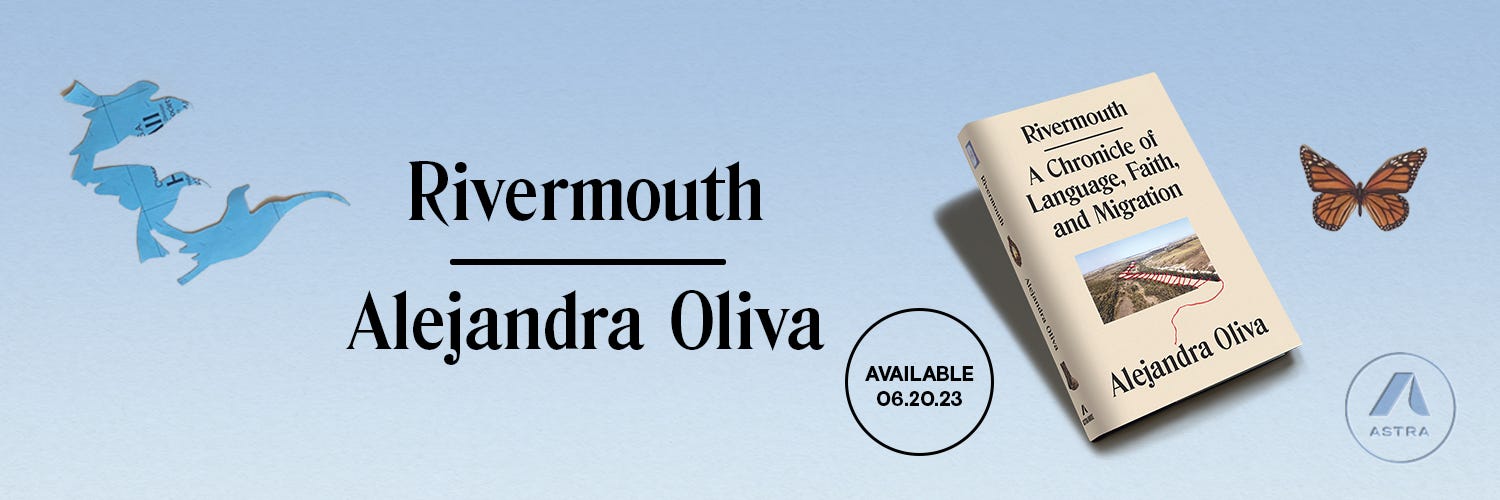
Also, I wrote a book. Rivermouth is about immigration, and language, and what it means to try to reach beyond yourself. Honestly, if you liked this newsletter, you will probably like this book.
What I’m Reading
Ways of Eating by Benjamin Wurgaft and Merry White. This is my second or third book on like Civilization and Cuisine and I don’t know that I’m getting a ton out of it that feels new, which is, to be very clear, my fault and not the books’.
I’m also in a real head-empty-hands-full spiral prevention mode, which means, to me, audiobooks and cross-stitching, so right now it’s Wolf Hall.
I did just finish Melissa Lozada Oliva’s Candelaria, which is about a Guatemalan grandmother at the end of the world, and is truly deeply delightful and weird.